Archive for August, 2009
Palace Museum
 August 26th, 2009 |
  Author:
 Address: Beijing, Jingshan Front Street, #4 (Jingshan Qian Jie, #4)
 The Palace Museum is situated in the center of Beijing, the capital city of China. It was established on October 10, 1925, and is China’s largest museum.
The museum is also known as the ‘Purple’ Forbidden City in Chinese, or the Forbidden City as it is commonly known in English. It covers 720,000 square meters and was the imperial palace for a succession of twenty-four emperors and their dynasties during the Ming and Qing periods of Chinese history. The museum is also China’s largest and most complete architectural grouping of ancient halls. Construction was begun in 1420, the eighteenth year of Yongle, so that the site has existed for the past 580 years. More than 70 halls of various sizes, containing more than 9,000 rooms, comprise the Forbidden City. These halls are aligned along a north-south axis, and extend out on either side in an east-west symmetry. The central axis not only passes through the Purple Forbidden City, but extends south to Yongding Gate and north to the Bell and Drum Towers, for a length of some eight kilometers.
This passage through the entire city of Beijing symbolizes the centrality of the imperial power: the imperial seat is at the very center of this line. The architectural design lines up the buildings in neat array and with imposing scale. In a concentrated form, this assemblage expresses China’s artistic traditions in the setting of China’s unique architectural style.
Entering the Forbidden City from Tian’an Men, one first moves straight through the Duan Gate to arrive at Wu Men, or the great Wu Gate. The popular name for Wu Men is the Five Phoenix Tower; this is the front entrance to the Purple Forbidden City. Going through Wu Men, spread out before one is a broad courtyard with the twisting course of the Jinshui Creek (Gold Water Creek) passing from west to east like a jade belt. Five marble bridges have been constructed over this waterway. Passing through the Taihe Gate to the north of the bridges one reaches the core of the Purple Forbidden City, the famous three great halls called Taihe Hall, Zhonghe Hall and Baohe Hall.
Taihe Hall is 28 meters high and occupies a space of around 2,380 square meters. It is the largest hall in the Palace. A red-lacquered dais around two meters high sits in its center, on which is placed a golden lacquered and carved dragon throne. Behind the throne is a screen carved with dragons and on either side of the dais are six great golden pillars with vigorous golden dragons coiling up them. In the recessed ceiling well above the throne is an extremely large coiled golden dragon, with a silvery pearl suspended from its mouth. The Taihe Hall was the location of the Emperor’s most important ceremonies, such as his own inauguration, his birthday, New Years, the arrival of winter, and so on.
Behind the Taihe Hall lies the Zhonghe Hall. This is a square hall with four ridge poles along the roofline that unite at the top in a large, round, gilded topknot called a baoding. The profile of the building is extremely beautiful. When the Emperor was about to officiate at important ceremonies, he would first rest in this building and receive visits of his various Ministers.
Behind the Zhonghe Hall is the Baohe Hall. In the Qing dynasty, every New Year’s Eve, the Emperor would hold a great banquet in this hall. This also was where the highest exam of the Ke-ju exam system was held. Emerging from the Baohe Hall and following the stone stairs downwards one arrives at an open rectangular courtyard. This space divides the Purple Forbidden City into front and back. To the south of the square are the three main Halls and, to east and west of them are the Wenhua Hall and the Wuying Hall. These are commonly called the ‘Outer Court,’ where the Emperor primarily conducted affairs of state. To the north of the square, inside the Qianqing Gate, was the Inner Sanctum. In the Qing dynasty, this is where the Emperor and his Empresses and Concubines lived. The main buildings include the Qianqing Palace, the Jiaotai Hall, the Kunning Palace, and six palaces to east and west. The Qianqing Palace was at one time where the Emperor slept. During the Qing dynasty, however, the emperors used this as a place of daily administrative affairs. Later emperors also met foreign emissaries here. Behind the Qianqing Palace is the Jiaotai Hall, which is where memorials to the Empress were conducted and where she received congratulations on her birthday. It also is where the Qing dynasty’s twenty-five ‘treasures’were kept, the twenty-five seals by use of which the Emperor manifested his rule. Behind the Jiaotai Hall is the Kunning Palace, which was originally a sleeping chamber for the Empress. Later in the Qing dynasty it was made into a place where offerings to gods were made and also where the Emperor was married.
 Posted in
Six Characteristics of Chinese Folk Arts
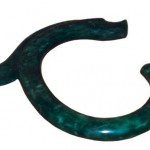 Chinese folk art is a visual art created by ordinary people to meet ordinary social needs. The definition of folk art is relative to the definition of the art of imperial palace, the art of aristocrats, and the art of scholars and of the literati, or professional artists. Firstly, it is a communal art created by millions in the working class, not the work of a few career artists. It is the art of the laborers, not the professionals; it is amateur, not specialized. Secondly, its social function makes it an art of necessity, used in everyday life, production, rites and ceremonies, and beliefs and taboos. It was not intended as a commercial commodity, nor to serve political needs.
Looking back on history to the age of primitive society, communal art was created by the Chinese people alongside the creation of tools, shelter and other basic appliances necessary in daily life. The emergence of social classes in society separated the art of the private career artist from folk art, thus forming two major art systems and two cultural heritages in China. The former was the communal art of the people and first came into being in prehistoric time; the latter was the art created by individual career artists and professionals. The parallel growth and mutual influences of these two types of art have been key in driving forward the mainstream of Chinese national art.
In terms of the conservation of national culture, the life of folk art is relatively stable. It represents the ideology of the community; the emotional and psychological characteristics of a nation throughout major periods in history. It is coexistent with national culture; it will not disappear as long as the community exists. Traditional folk art will, however, continue to grow and expand with the passage of time. Cross-cultural exchange and development will continually inject new life into folk art by bringing fresh materials and ideas. Its core, however—its cultural and philosophical origin, its Chinese cultural genes—will remain unchanged.
Chinese folk art has six basic features:
1. It is the art of the people and by the people. The creators are the vast majority of ordinary people as a group.
2. It is the art for the people. It is intended to meet the needs of their daily work, food, clothing, shelter and transportation; as well as their social life of festivals and ceremonies, of beliefs and taboos.
3. Its cultural implication and art forms are reprehensive of the world view of the community, their aesthetics, their motional and psychological characteristics and national spirit. It reflects the system of philosophy, art and 9 color composition in the original Chinese culture. Some popular categories include paper-cutting; floury flower; dress and ornament; embroidery; dye and knitting; exerciser related masks and customs; painting; New Year picture; leather silhouette; puppet; toy; kite; paper folding and lighting art; folk theatrical mask; chess; puzzle; pottery; engraving; residential building; vehicle decoration; household appliance; etc.
4. It is a sector of Chinese parent art. Emerged in primitive society, Chinese folk art inherited the cultural tradition of national literature and art development throughout each and every period in a history of over several thousand years.
5. It is distinctively characterized by individual nationality and geographical region.
6. It is created with commonplace tools and indigent raw materials, characterized by rural natural economy of the region.
In sum, folk art is a unique sector among Chinese national art that enjoys the most popularity and with the richest resource of historical culture. It is directly embedded in people’s every day life and best characterized by the geographical region it represents. It is a long-standing, signature art form of Chinese nation with over 8000 years of history and cultural progress going all the way back to primitive society. From the worship of nature, totem and ancestor; to the urban residence culture of modern capitalist commodity economy; the cultural identity of each h istorical period is recognizable in single piece of art work in some cases. It is truly a living fossil and a museum of national historical culture.
View of China’s museums
China has an ancient civilization with a very long history. Understanding it 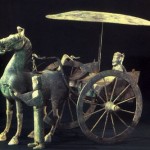 solely through the study of documents is clearly inadequate. A wealth of objects and remains has been preserved on China’s vast territory and underground; much of which has been collected and is exhibited in various kinds of museums. This raw material of history can, in a certain sense, be considered more valuable for our understanding of the past than documents and historical records.
One can see many of China’s cultural treasures in Western museums. Some of these are exquisite works of art, but at the same time they are fragments that have been removed from the original matrix of their being. To enjoy a complete and systematic experience of Chinese cultural history, one must visit the museums of their native land. Although there are Dunhuang sutras in the British Museum, stolen by Aurel Stein, Dunhuang itself and the center of Dunhuang Studies remain in China. Although quite a few treasures from the Summer Palace were looted by British and French troops and are now exhibited in France at Fontainebleu, the majority of choice pieces remains in the Palace Museum in Beijing.
In the past, China’s antiquities and most artworks were kept in the recesses of the reshidences of aristocratic families and the imperial clan. The public at large was not able to see them. China’s modern museums started from the Westernization Movement of the early twentieth century and the overthrow of the feudal imperial court during the Xinhai Revolution (1911). Only a????er this was the public allowed to enter the halls and pavilions and enjoy the fruits of the civilization of their own ancestors. In the past twenty to thirty years, due to China’s opening and reform policy as well as to the development of a market economy, travel, tourism, and cultural exchange have greatly increased. China’s socialist museums have developed along with these changes: they have been rebuilding and exp anding old museums, adding new buildings, increasing collections, modernizing exhibition facilities and strengthening archaeological research. There are now some 2,000 museums in China of all varieties. Visitors from both China and abroad have increased, with very positive results in the realm of education as well as in simple enjoyment.
Museums are a sort of three-dimensional encyclopedia In the West, the Goddess of the Muse has been considered a kind of guide to Western culture. The Temple of the Muse at Atlantis was originally a comprehensive cultural arts organization and Western museums harken back to this early beginning. In China, museums originated in the collections of the ancient imperial families. They too were of a comprehensive nature and the cultural guide to the East was termed a ‘bo-wu’ gentleman, or a man in command of broad or extensive matters. The term “museu” in China, ‘bo-wuguan,” means a place devoted to broadly-conceived matters.
Many of the museums selected for this book have been designated as key protected cultural sites by China. Some have been included in the United Nations’ UNESCO List of World Cultural Heritage Sites. I hope that this volume can serve visitors as a guide to understanding these museums.
Peking Opera
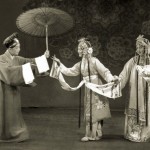 Foreign visitors to China (especially in Beijing) usually first visit the Great Wall, the Forbidden City and the Temple of Heaven, representative sites of historical interest in the city. In the evening, a tourist guide will take foreign visitors to the Chang’an Grand Theater on the Avenue of Enduring Peace. In the foyer are counters selling handicraft articles, Peking Opera masks and Peking Opera-related books, picture albums and audio-video products.
Inside the theater, the stage is of a Western style; seats in the middle and rear rows are soft sofas; but in the front rows are exquisite Chinese-style square tables and armchairs. The traditional seats lend the theater a classical flavor.
Sitting in your seat, you might take a look at the Chinese fans around you. They all have a relaxed expression and wear ordinary clothes. Many of them are speaking in each other’s ears. But as soon as the gong and drum strike up, they all calm down and watch the play intently. As the plot unfolds, they seem to know who should be the next to come onto the stage and when to applaud a particular actor or actress for his or her performance.
More surprising, aside from applause, Chinese audiences show their appreciation for the performance of actors and actresses by shouting “hao!” It turns out that this means simply “well-done”or “bravo”.
 Tags:
Tags: